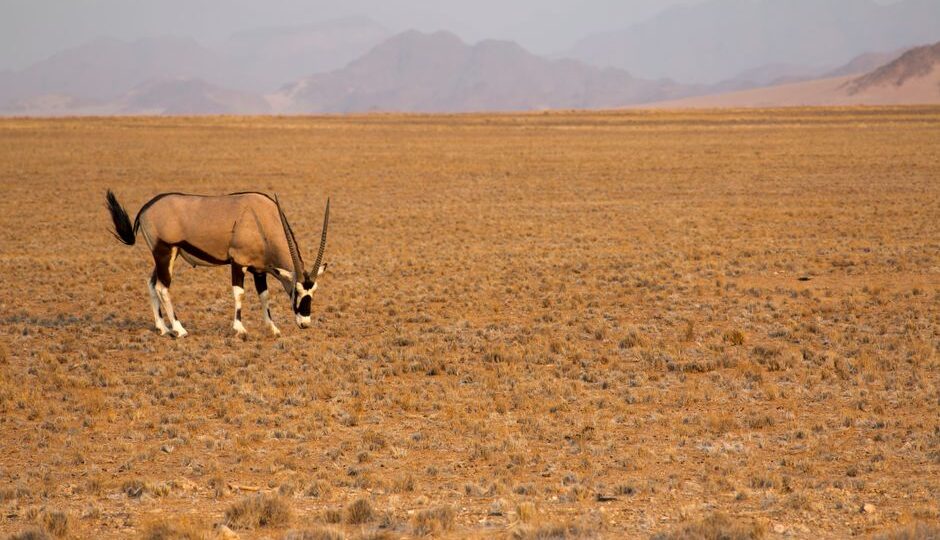
In the summer of 2026, under the vast and mysterious canopy of the Namib Desert’s night sky, an event unfolded that left scientists, tourists, and locals alike scratching their heads in disbelief. What was initially thought to be a mere mirage or urban legend turned out to be a magical spectacle: the Moonlit Menagerie.
The Unexpected Invitation
It all started with a group of astrophotographers who had set out to capture the annual Perseid meteor shower. As they settled around the famous Spitzkoppe, known for its stunning rock formations resembling a natural stone archway to the stars, something extraordinary occurred. Animals from the surrounding area began to gather, seemingly drawn by some unseen force.
Witnesses reported seeing meerkats, zebras, and even the elusive aardvark converging as if attending a cosmic concert. Their movements were synchronized and fluid, resembling a well-rehearsed ballet rather than random wildlife behavior. It was as if the desert itself had come alive, orchestrating this dance under the moonlit sky.
Scientists and Skeptics Unite
Word of the Moonlit Menagerie spread like wildfire, drawing the attention of scientists from around the world. Dr. Elara Nyx, a renowned biologist from the University of Cape Town, was among the first to arrive, equipped with state-of-the-art equipment and a team of dedicated researchers.
“We initially thought it might be a new behavioral phenomenon or perhaps a reaction to environmental changes,” Dr. Nyx explained. “But the more we observed, the more we realized that this was something else entirely.”
Theories ranged from the plausible—such as pheromonal signals or auditory cues imperceptible to humans—to the outright fantastical, with some suggesting extraterrestrial influence or even a rift in space-time. Yet, despite extensive research, the cause of the Menagerie remains a mystery.
The Lunar Connection
One of the most striking aspects of the event was its apparent connection to the lunar cycle. Observations showed that the phenomenon only occurred during full moons, leading to speculation about the moon’s gravitational effects on Earth’s animals.
Animal behaviorist Dr. Rajesh Patel noted, “While the moon has been known to affect animal behavior, such as spawning in marine life or the hunting patterns of nocturnal creatures, this level of coordination among distinctly different species is unprecedented.”
As scientists continue to investigate, telescopes and cameras have become a permanent fixture around Spitzkoppe, capturing each occurrence of the menagerie in stunning detail.
Tourists Flock to the Desert
As news of the Moonlit Menagerie spread, tourists began to flock to the Namib Desert, hoping to catch a glimpse of this surreal event. Local businesses have thrived, with eco-friendly lodgings and guided night tours springing up to accommodate the influx of curious visitors.
Guides like Amara Keitumetse have become celebrities in their own right, leading groups on moonlit treks and recounting the tales of past sightings. “Every time it’s different,” Amara says. “Sometimes the animals form intricate patterns; other times, they move in waves, like the ocean under the stars.”
A Practical Takeaway
While the Moonlit Menagerie remains a captivating mystery, it serves as a reminder of the wonders of our natural world and the importance of preserving these unique habitats. For those looking to witness this marvel firsthand, experts recommend planning visits around the full moon and respecting the delicate balance of the ecosystem by adhering to sustainable travel practices.
Whether it’s a natural phenomenon or something beyond our current understanding, the Moonlit Menagerie of 2026 has left an indelible mark on our imagination, reminding us of the endless possibilities that lie within the dance of the cosmos.